
It is when one looks away from the immediate song and dance and at the granular detail of what has been going on since 2014 that one realises what the quality and competence of thinking and execution is in this project we call New India, asserts Aakar Patel.

As the temple is inaugurated, unfortunately for Advani but unsurprisingly for the rest of us, the architect of the party's rise will not lead the ceremony and claim credit for his achievement, notes Aakar Patel.
Given the reality of the disparity and the enormous shift over the last 50 years, this can be done without an open and frank conversation with the people, something that has not begun and, knowing the style of our leader, is not expected to begin, asserts Aakar Patel.

An unofficial and brutal justice system exists parallel to the official one, and it executes many times more of the accused than the official one executes convicts, points out Aakar Patel.

One hopes, though one is not optimistic, that this action to some extent corrects the lunacy which has infected our national media and has damaged our nation, notes Aakar Patel.

This form of government, where secrets and major decisions are kept from the Cabinet itself, appears to be continuing, which is why the speculation around this special session, asserts Aakar Patel.

History would not see the institution kindly if it continues to avoid, as appears to be the case, hearing and deciding some of the most pressing issues of our time, asserts Aakar Patel.
In constitutional democracies the Opposition is legitimate and part of the legislature. To see it as the enemy and to try and get rid of it through convictions and expulsions is not democratic, asserts Aakar Patel.
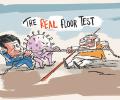
Dominic Xavier offers his take on the challenges confronting the Modi government.
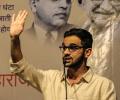
Arrested in September 2019 by the Delhi police for making 'provocative statements' when Donald J Trump was on his visit to India, Dr Umar Khalid has now spent three years in jail without being convicted of an offence, points out Aakar Patel.

Despite the objections raised by Reserve Bank of India and Election Commission, India's politics has been funded anonymously and it is time to end this, asserts Aakar Patel.

India is attempting to soft-land a rover on the moon and will attempt, at some point next year hopefully, sending humans into orbit. All of this makes an exciting time for space around the world, notes Aakar Patel.

Dominic Xavier asks if it is right to blame coronavirus and the lockdown for India's economic decline.

My followers and devotees will not have to suffer the trauma of seeing me accept that something wrong has happened under my watch, observes Aakar Patel.

Given that the BJP made all these moves and that these moves were presumably approved by Modi if not directed by him, who should accept the responsibility for the party's rout? asks Aakar Patel.

Happily, it does not require the world to hold a mirror up for us. We can look at ourselves and understand easily if we choose to be honest about where we find ourselves three quarters of a century after Independence, asserts Aakar Patel.
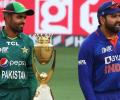
Boycotting the Champions Trophy will not tackle the issue we have with Pakistan, points out Aakar Patel.

Particularly the small and independent Web sites that have developed a following in the recent past because the mainstream is seen as totally aligned with the government, points out Aakar Patel.
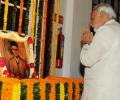
It is a question that his supporters must ask of the prime minister. It may be enjoyable for them to pass through this phase of going after other Indians. But once this has been achieved to satisfaction, then what?, questions Aakar Patel.

India's national security focus has shifted from the western border to the eastern one. But our trade with China keeps rising. This trade is against our interest, because most of it comprises of Chinese imports, argues Aakar Patel.

The Uttar Pradesh government on Friday defended its directive requiring eateries along the kanwar yatra route to display the names of their owners and staff, saying the idea was to bring in transparency, avoid 'potential confusion' and ensure a peaceful yatra.

Our focus is not on substance, but communicating how we did not shake hands and how we made angry faces. This is what India's foreign policy has become, notes Aakar Patel.

The rhetoric that we are fed daily needs to be measured against performance and the facts. That is not happening, points out Aakar Patel.

NITI Aayog has not said what the reasons were for having achieved or not having achieved what was sought to be achieved, or what lessons can be learned for the future, points out Aakar Patel.

In our mystery the watchdog agencies are silent, but it is the market that has barked and has not stopped barking. Till such time as it continues to do so, this headache will not go away, notes Aakar Patel.
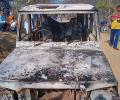
Not many modern democracies have gone down this path before, setting it upon themselves to use the law and media to target citizens, points out Aakar Patel.

The most positive development over the last 60 years is the political empowerment of disadvantaged groups, introduction of the committee system and better policing of members. However, we still need to address the issue of dysfunctionality of Parliament, MPs' disdain for law making and the absence of periodic audit of the working of Parliament by independent citizens, says A Surya Prakash.

Bhima Koregaon represents what the government can do in India against well meaning people who speak up against atrocities, who stand up for the weak and the dispossessed and for this reason alone as seen as enemies of the State and kept in prison for as long as the government can manage. So long as the rest of us do not speak up against this misbehaviour by the State, so long as we forget about those who have been made its victims, this behaviour will continue, asserts Aakar Patel.
'He doesn't think anyone else has his brilliance or integrity. And he cannot bear to stand a rival,' says journalist Aakar Patel, a long-time Modi observer who has translated Modi's poetry and his biographies of RSS leaders.
Give this fact that the middle class is not responsible in India and cannot be trusted to lead, it is remarkable that our legislature, even given all of its vulgar traits, has performed as superbly as it has, notes Aakar Patel. The first column in a series as India celebrates the 60th anniversary of the first sitting of the Joint House of Parliament on May 13.
Parliament is essential to the success of Indian democracy and the citizenry should be in the forefront of demanding reforms which help improve and strengthen Parliamentary democracy, says Rohit Pradhan.
'India's parliamentary democracy is ridden with flaws,' argues Rajeev Srinivasan. 'Parliament has become a monarchy, with seats captured by a strongman, and then inherited by his wife or children.'
There is no mechanism for the people to intervene in the affairs of Parliament, to direct it to enact laws on particular subjects, to prevent it from passing certain other kind of laws. The People are supreme, not Parliament. But unfortunately, in India, the People do not have any control, whatsoever, on the functioning of Parliament, says Arvind Kejriwal. Exclusive to Rediff.com

A protest happens because the State doesn't follow its own laws. A protest is an objection and a complaint. It exists because it is otherwise unheard, observes Aakar Patel.

One wonders what, given the recent past, the next quarter century holds in store for India, asks Aakar Patel.
The history of our nation may not always have charted a linear trajectory to greatness. But that must not distract us from recognising that we as a nation we continue to find new and innovative ways to reconcile contradictions, transcend fault-lines thus avoiding the pitfalls of so many of our neighbours, says Shashi Shekhar.

On such things as the meat ban and hijab ban, we are finding that elements that comprise the system are enthusiastic about denying people their rights. It says something awful about us as a society, asserts Aakar Patel.
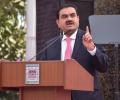
So far the government has been silent on the charges being levelled, even after the stock price rout. Perhaps it is hoping for the share price to settle so that the matter goes away, predicts Aakar Patel.

When was the last time we heard this government speaking of the disaster in primary education, rather than Ganga cruises and cheetahs? Less money -- Rs 88,000 crore -- was spent by the Union government on education in its last Budget than has been allocated to the Bullet train, notes Aakar Patel.
Years ago, as finance minister, Manmohan Singh popularised the term 'systemic failure.' Today he appears to believe it is a case of individuals being at fault rather than the system. I believe he was wrong then and is wrong now, says T V R Shenoy.
